What this page answers
- Is it worth it for a short trip? It is a candidate if your days stay inside Seoul, with several subway or bus rides a day on consecutive days. Is it worth it?
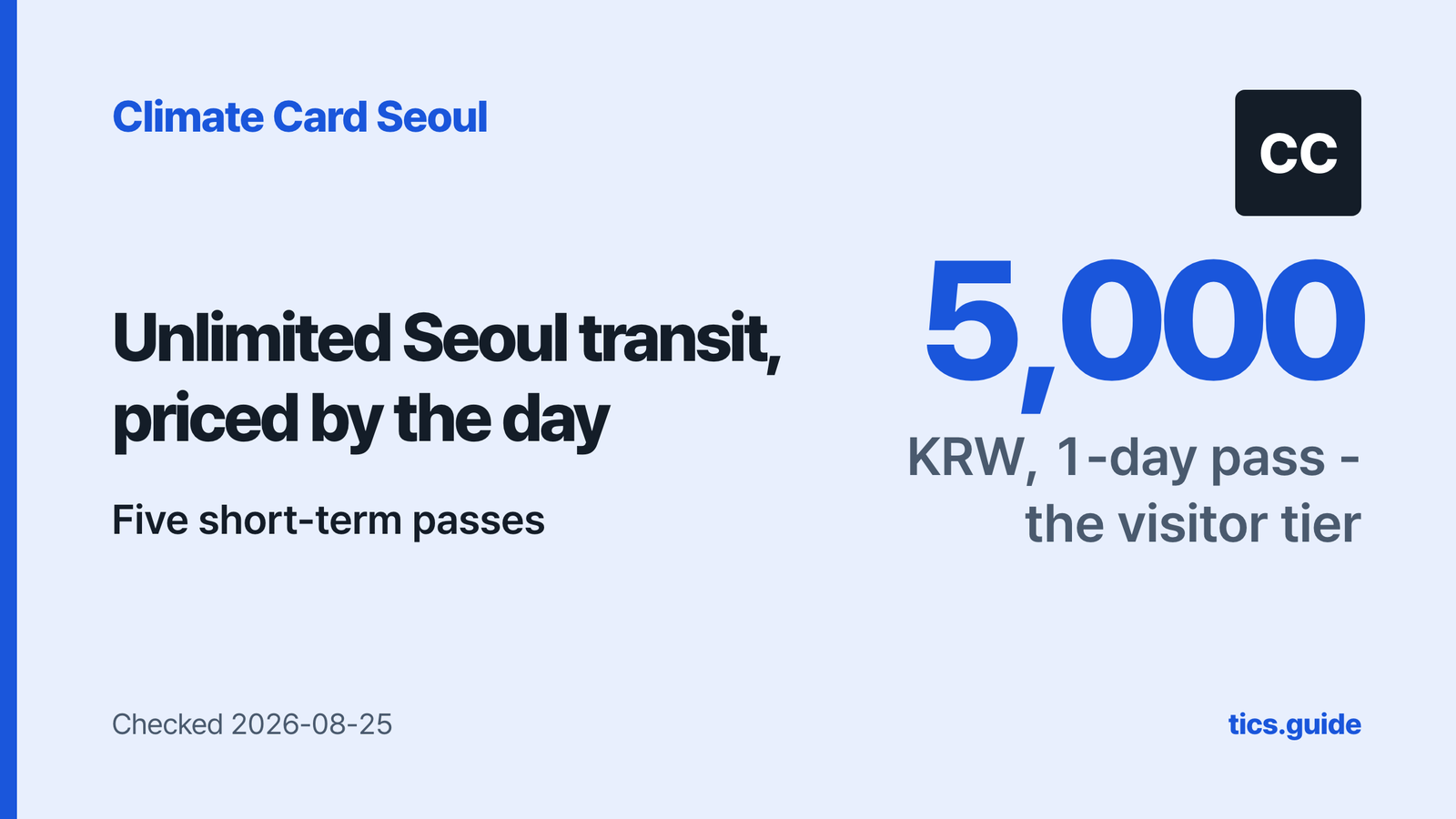
- What does it cost? A physical card is KRW 3,000, and short-term passes run 5,000, 8,000, 10,000, 15,000 and 20,000 won for 1, 2, 3, 5 and 7 days. Buying and loading
- When should I load the pass? On the morning you start using it. The valid term begins on the date of charging, and you cannot charge a card in advance — the start-date option is marked as excluding short-term passes. Buying and loading
- Where does it stop working? The Sinbundang Line, metropolitan and airport buses, buses registered to other regions, and boarding AREX at Incheon Airport. You may get off at Terminal 1 or Terminal 2 on it, but not board there. Where it works
- Can a visitor get the new Climate Pass? No. Sign-up needs a Foreign Resident Registration Number, and eligibility is based on living in Seoul. Short-term passes stay on sale. What changes in September 2026
- Can I get money back if I do not use it all? Only the latest short-term pass topped up with cash or an overseas card is refunded in cash at T-Town, balance less rides less KRW 500, over two visits before it expires. Getting money back
The Climate Card is a flat-rate pass for public transport inside Seoul. This page asks whether it fits a short visit, and covers the switch under way: the 30-day version retires during September 2026, and a resident-only product replaces it.
Is the Climate Card worth it for a short trip?
The short-term pass is the Climate Card product a visitor can still buy: the 30-day and postpaid versions are being withdrawn, and the 1-, 2-, 3-, 5- and 7-day passes are not.
Whether it suits you turns on one question: does your itinerary stay inside Seoul? It is a candidate if you plan several subway or bus rides a day within the city, on consecutive days.
It is not a candidate for the parts of a trip that leave the city: the Sinbundang Line, subway sections outside Seoul, airport buses, and boarding AREX at Incheon Airport are all outside it.
What changes around September 2026
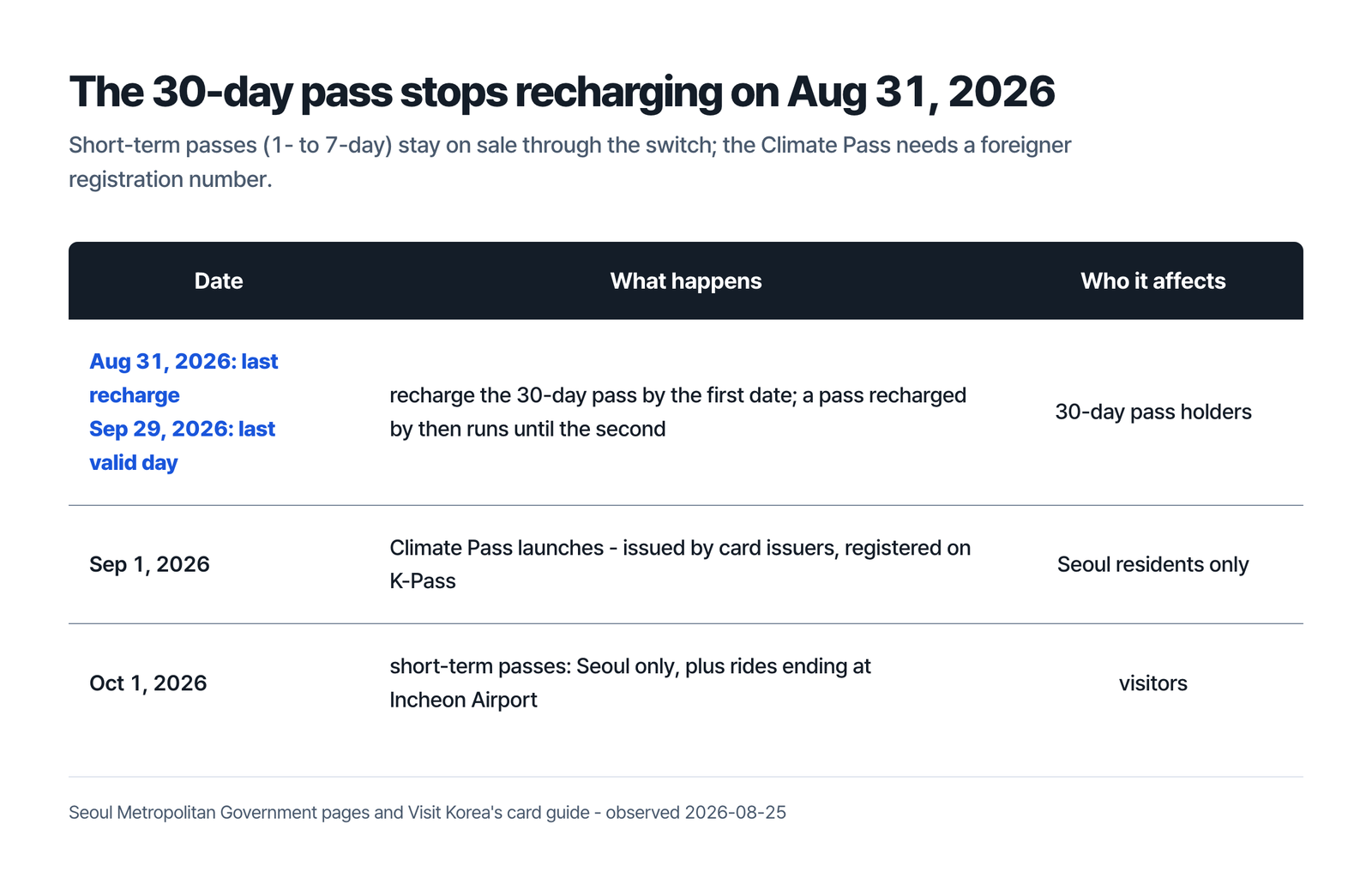
Four dates matter. August 31, 2026 is the last day to recharge the prepaid 30-day Climate Card, on Seoul’s own page and the tourism board’s guide alike. September 29, 2026 is the last day a pass recharged by then can be used, which Seoul’s Q&A article calls the final day of its validity period.
September 1, 2026 is the release date of the Climate Pass. Seoul’s page routes registration through the K-Pass website and states that sign-up needs a foreigner registration number; its Q&A article says only foreigners with a Foreign Resident Registration Number can sign up. Eligibility is based on place of residence, and the pass is for Seoul residents.
October 1, 2026 is when the short-term pass narrows. Korea Tourism Organization’s guide states the Climate Card is limited to use within Seoul starting October 1, 2026. Seoul’s Q&A article gives the detail: short-term passes stay valid within Seoul and for trips ending at Incheon International Airport, and Gimpo, Goyang, Gwacheon, Guri, Seongnam, Hanam and Namyangju drop out.
Buying the card and loading a short-term pass
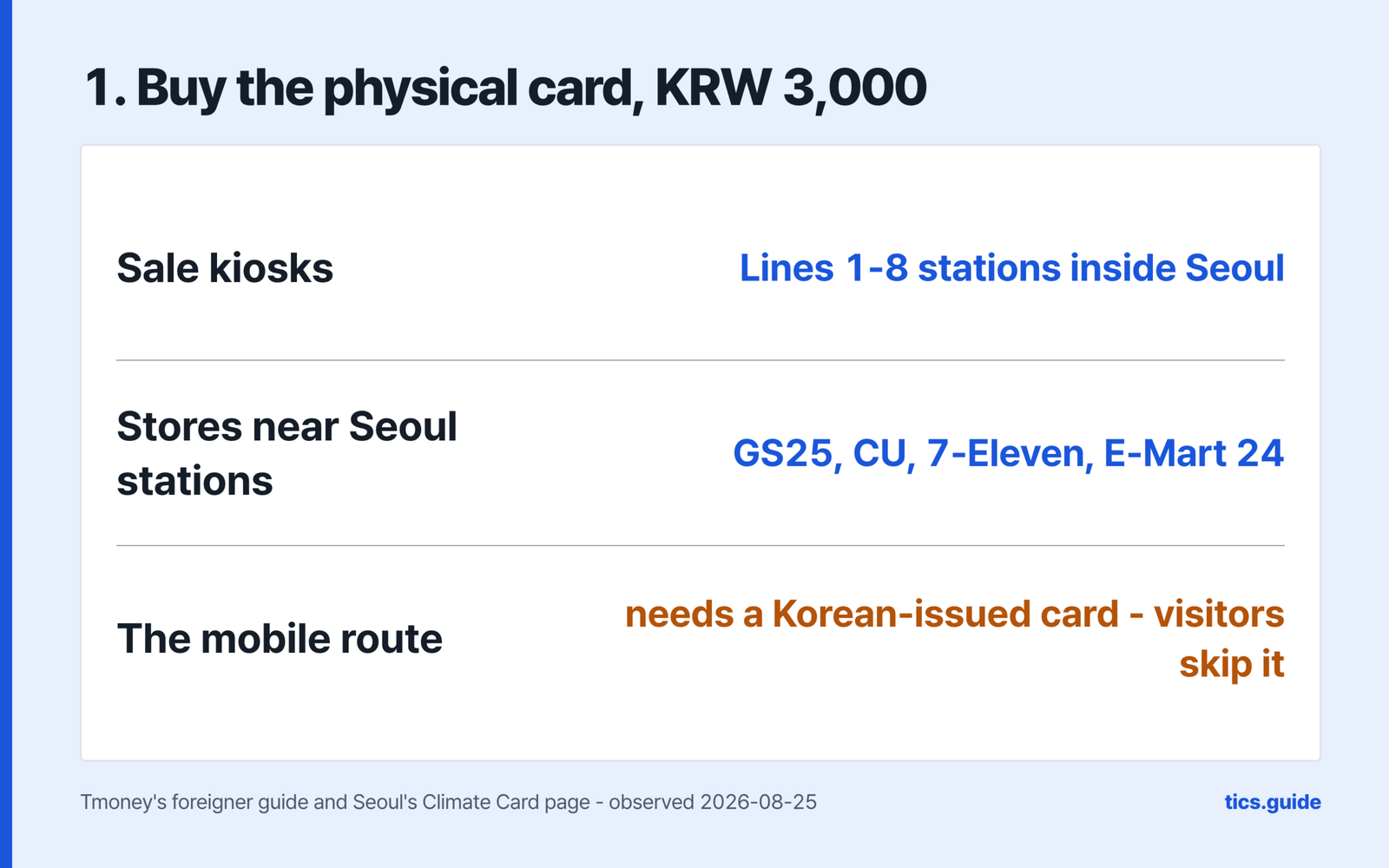
Tmoney’s foreigner guide sets out where the physical card comes from. Sale kiosks inside Lines 1 to 8 stations in the Seoul area sell it for KRW 3,000. Convenience stores near Seoul subway stations sell it too, card and cash accepted, the guide naming GS25, CU, 7-Eleven and E-Mart 24. It warns that a surcharge may apply to cards issued outside Korea.
The mobile version is a dead end for most visitors. Seoul’s page issues it through the Tmoney app on Android OS 12 or later, and takes payment by bank wire transfer or a domestic credit or debit card issued in the user’s own name.
Card in hand to pass loaded
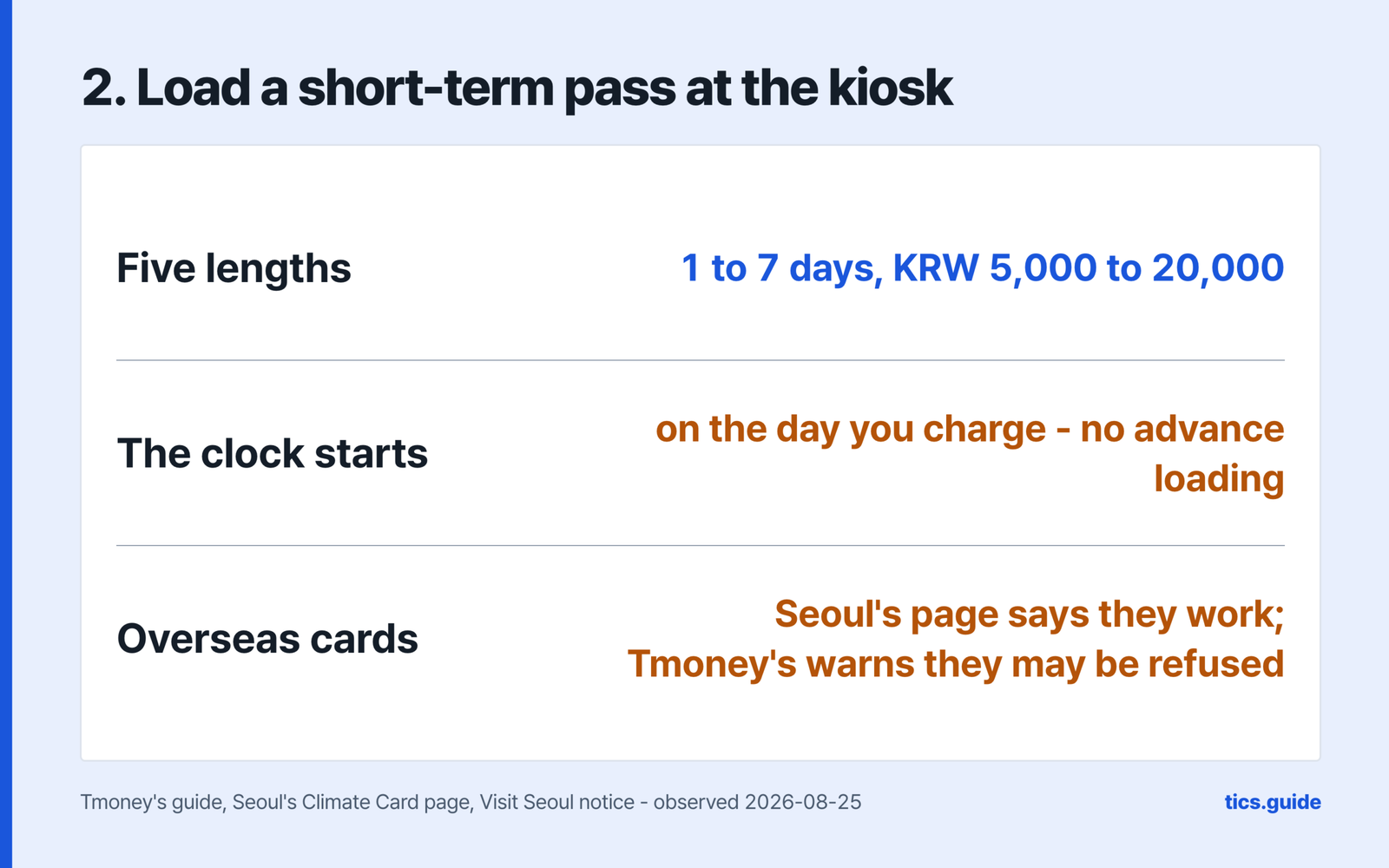
Loading is where the timing rule bites. Seoul’s Climate Card page states that the valid term begins on the date of charging the card, and that you cannot charge a card in advance. The option to pick a start date is marked as excluding short-term passes. Buy the card whenever you like, but load the pass on the morning you intend to start using it.
Overseas cards are described two ways. Seoul’s page and a Visit Seoul notice each state that Climate Cards and short-term passes can be bought and recharged with cards issued abroad. The machines are the ticket vending machines on Lines 1 to 8, with Line 1 counting only between Cheongnyangni and Seoul Station. Tmoney’s guide is more cautious: cards issued outside Korea may not be accepted, or may carry a surcharge. Carry cash as a fallback.
Two reloading limits are easy to trip over. Tmoney’s guide states that at the Gimpo Gold Line you can only charge the card with cash. It also states that reloading is not available for KORAIL, Airport Railroad or the Shinbundang Line, so the AREX platform is no place to top up.
Where the Climate Card works, and where it stops
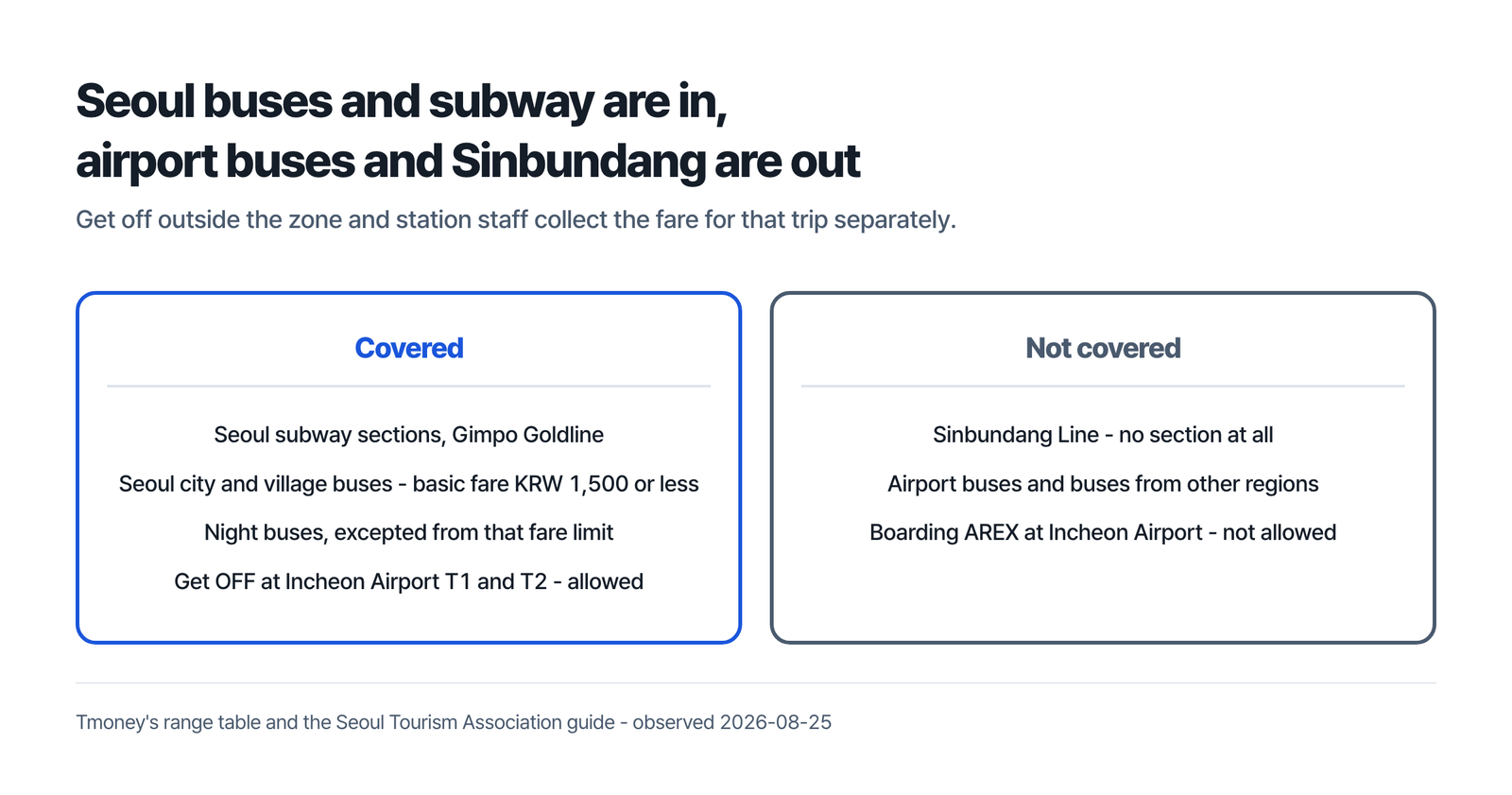
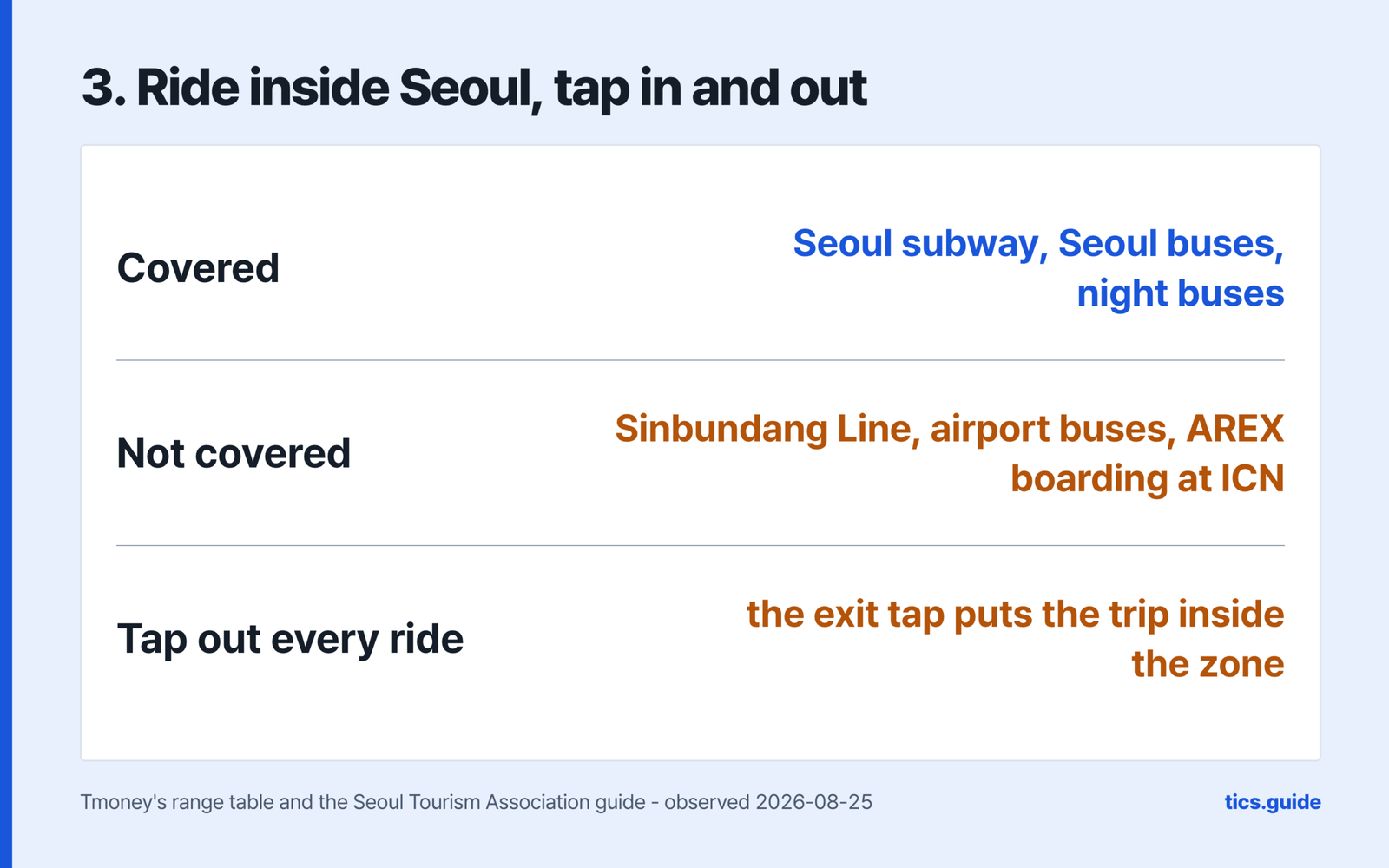
The covered list is short. Tmoney’s guide names Seoul subway and the Gimpo Gold Line, city and village buses registered to Seoul including late-night buses, and the Seoul public bike Ttareungi. The bus entry carries a limit in the original: coverage is confined to public transport with a basic fare of KRW 1,500 or less, with night buses named as an exception.
Ttareungi has a catch: the same guide requires a Korean authentication method such as I-PIN, which the pages read here give a visitor no route to.
The exclusions are where trips go wrong. Metropolitan and airport buses are out, along with buses registered to other regions such as Gyeonggi and Incheon. The Sinbundang Line row in Tmoney’s route table shows no usable section, and the Seoul Tourism Association page says the same in words. Airport Railroad appears in that table as Gimpo Airport to Seoul Station only, and Seoul’s page prints the same segment.
Incheon Airport has its own clause, written by two sources. Tmoney’s guide states that after boarding at a station in the Seoul area you can get off at Incheon Int’l Airport Terminal 1 and Terminal 2, then adds that you cannot get on at those stations. The Seoul Tourism Association page states the same exception in its own words. A Climate Card can carry you out to the airport, but it will not let you board there for the ride into town.
Straying outside the zone is a charge rather than a refusal. Tmoney’s guide states that getting off at an excluded station adds a fee. Its worked example is a Seoul Station to Bupyeong Market trip: the card cannot be used, and station staff collect that trip’s fare separately.
Korea Tourism Organization’s guide also puts GTX outside the card. The Tmoney and Seoul Tourism Association pages read here name the Sinbundang Line but not GTX, so that exclusion is repeated here as the tourism board’s wording.
Two concert venues show where that boundary falls. KSPO Dome sits on the Seoul subway, so the card covers the ride there and back: our guide to getting to and from KSPO Dome, which carries the last-train times. Our guide to INSPIRE Arena on Yeongjong Island covers a venue in Incheon, and travel to and from that island needs a separate fare.
Tap in and tap out every ride: the exit tap is what puts the trip inside the zone.
Short-term pass, 30-day pass, or the Climate Pass?
| Short-term pass | 30-day pass | Climate Pass | |
|---|---|---|---|
| What it is | Seoul’s unlimited public transit pass, in Korea Tourism Organization’s words available in 1- to 7-day options | The 30-day version of the same pass, in four coverage tiers | From September 1, 2026, Seoul’s combination of the Climate Card and the national K-Pass refund scheme |
| Price | KRW 5,000, 8,000, 10,000, 15,000 or 20,000 for 1, 2, 3, 5 or 7 days, plus KRW 3,000 for the physical card | KRW 62,000 to 70,000 by coverage tier, plus KRW 3,000 for the physical card | Not compared here |
| Valid | The term begins on the date of charging. You cannot charge a card in advance, and the start-date option excludes short-term passes | Rechargeable until August 31, 2026, and usable until September 29, 2026, the final day of its validity period | Released September 1, 2026 |
| Who can get it | Sold over the counter, cash or card; Tmoney’s guide warns cards issued outside Korea may be refused or carry a surcharge. The pages read here set out no registration step for buying or loading | Being withdrawn: from October 1, 2026 the 30-day and postpaid Climate Cards are discontinued | Seoul residents. Eligibility is based on place of residence, and only foreigners with a Foreign Resident Registration Number can sign up |
| Where it comes from | Sale kiosks in Lines 1-8 stations inside Seoul, and convenience stores near Seoul subway stations (GS25, CU, 7-Eleven, E-Mart 24) | The same counters | Not compared here |
Getting money back before the pass expires
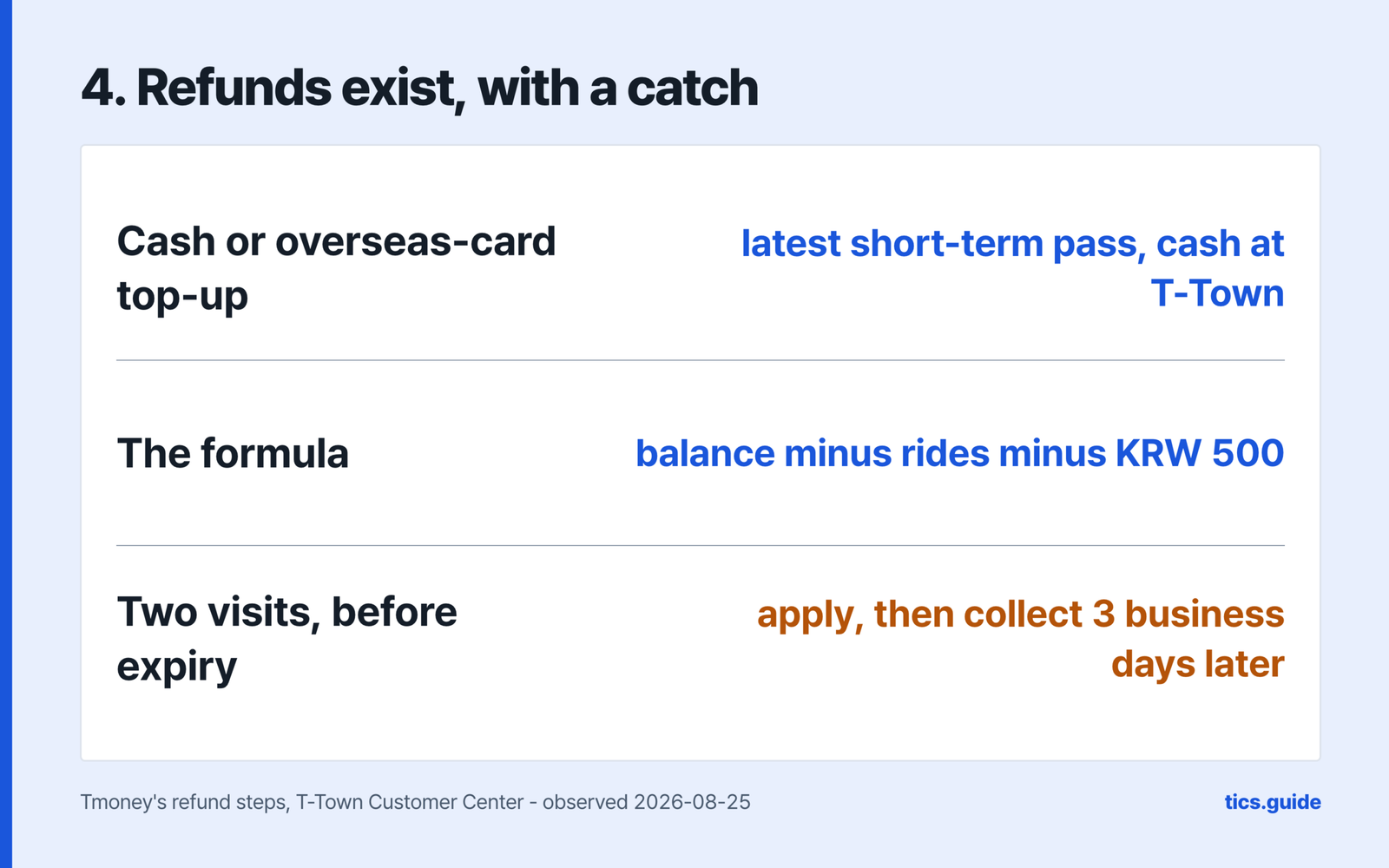
Only the latest short-term pass loaded with cash, or with a credit or debit card issued outside Korea, can be refunded in cash at the T-Town Customer Center. That carve-out in Tmoney’s guide is the visitor’s route, and no Korean bank account appears in it.
The account condition belongs to the other route. The same guide states that refunds for the 30-day pass, or where funds were added by card, are possible after signing up on the T-money website, and that you must have a Korean account in your name. Seoul’s Climate Card page states that foreigners without a bank account in Korea can visit the Tmoney headquarters to receive a refund. Whether that headquarters is the same place as the T-Town Customer Center is not settled by the pages read here.
The sum is published either way. The remaining balance comes back less the amount actually used on public transport and Ttareungi, and less a KRW 500 refund fee taken from the reload amount. The card value itself is not refundable, which the guide states for normal cards.
The procedure is a counter errand in two visits. Steps ① to ⑤ begin at an unmanned card reload machine in a station on Lines 2-9, the Ui-Sinseol or Sillim Line, or Line 1 between Seoul Station and Cheongnyangni. There you scan the card and press the Refund (Stop Card Use) button to stop it. They finish at the T-Town Customer Center, on the first floor of Seoul City Tower at 110 Huam-ro, Jung-gu, where you confirm eligibility and fill out a receipt. A passport may be required. Step ⑥ is a second visit to that counter three business days later, to collect the cash.
The deadline is the pass, not your flight. The guide states that steps ① to ⑤ must all be completed within the period of use, and that steps ① to ③ and the T-Town visit must happen before the expiration date.
Before you buy, and on the day
- Whether your days stay inside Seoul. Anything past the city boundary, including the Sinbundang Line, is a separate fare.
- How you are reaching the airport. Airport buses are outside the card, and you cannot board AREX at Terminal 1 or Terminal 2 on it.
- Cash in hand at the machine, because the official pages describe overseas-card acceptance differently.
- Loading the pass on the morning you start using it, since the term begins the day you charge and cannot be set in advance.
- Your passport, which the refund procedure may ask for.
- Two visits to the T-Town Customer Center before the pass expires, if you intend to claim the unused balance back.
- Tapping in and tapping out every ride, because where you get off decides whether the trip is inside the zone.
What this page leaves open
Fares and dates move. Everything above was read on 2026-08-25, and the September 2026 switch is in progress as this page goes out.
Can I use the Climate Card from Incheon Airport?
Not for boarding. Tmoney’s guide and the Seoul Tourism Association page each allow getting off at Terminal 1 and Terminal 2 after boarding inside Seoul, and each rule out boarding there. Airport buses are excluded too.
Is the Climate Card still sold after September 2026?
The short-term passes are, as the verdict above sets out. The 30-day pass could be recharged until August 31, 2026 and used until September 29, 2026.
Can visitors get the new Climate Pass?
No. Seoul’s Q&A article limits sign-up to foreigners with a Foreign Resident Registration Number, and its Climate Card page ties eligibility to living in Seoul. The short-term pass is what remains for a visitor.
Do overseas credit cards work at the machines?
Seoul’s page and Visit Seoul’s notice each say yes. Tmoney’s guide still warns that cards issued outside Korea may be refused or carry a surcharge, so carry cash.
Getting around Seoul on a visit
- Is the Climate Card worth it?
- Which card is actually called what
- Incheon Airport to Seoul
Read on 2026-08-25
- 한국스마트카드 (Tmoney), Climate Card guide for foreigners – https://pay.tmoney.co.kr/ncs/pct/ugd/ReadClmtAcmpCardFrgnGd.dev
- 서울특별시, Climate Card policy page (read in a browser) – https://english.seoul.go.kr/policy/transportation/climate-card/
- 서울특별시, Q&A on the Climate Pass launch, posted 2026-08-20 (read in a browser; the October 1 narrowing is dated by source 4 and detailed by this page) – https://english.seoul.go.kr/smg-steps-up-outreach-ahead-of-climate-pass-launch-on-september-1-encouraging-early-card-conversion/
- 한국관광공사, “Transportation Cards”, updated 2026-08-03 – https://english.visitkorea.or.kr/svc/contents/contentsView.do?vcontsId=140663
- 서울특별시관광협회, “Transportation Card / Travel Pass”, edited 2026-06-01 – https://tiac.or.kr/lang_en/cardpass.php
- 서울관광재단, “Notice: Climate Card Top-up via Overseas Credit/Debit Cards”, posted 2026-03-06 – https://english.visitseoul.net/announcements/Notice-Climate-Card-Top-up-via-Overseas-CreditDebit-Cards-/ENB014088